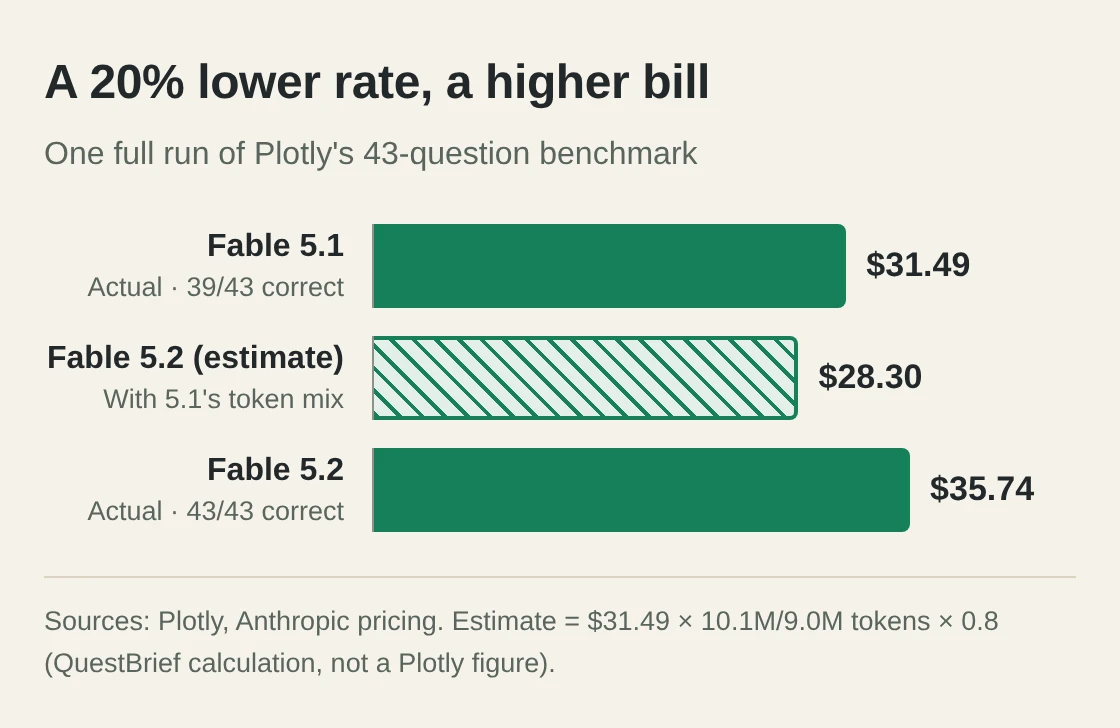
Eighty-one cents per correct answer. That’s what Fable 5.1 cost on Plotly’s 43-question data analysis benchmark: $31.49 for 39 right answers. Fable 5.2 ran the same exam for $35.74 and got all 43, which works out to 83 cents each. So the model that’s 20% cheaper per token costs about 3% more per correct answer.
Anthropic released Claude Fable 5.2 on November 9 at $8 per million input tokens and $40 per million output tokens. Fable 5.1, still listed on Anthropic’s pricing table, was $10 and $50, so the cut is exactly 20%. Plotly’s total bill still went up 13.5%. If you’re deciding whether to move API traffic to the new model, the interesting part is why, and Plotly published enough of its invoice to work that out.
The 20% cut really does apply to everything
The first suspicion is that Anthropic only cut the headline rates. The prompt caching docs say otherwise:
| Per million tokens | Fable 5.1 | Fable 5.2 | Opus 5.5 |
|---|---|---|---|
| Base input | $10 | $8 | $4 |
| Cache write (5 min) | $12.50 | $10 | $5 |
| Cache read | $0.25 | $0.20 | $0.20 |
| Output | $50 | $40 | $20 |
Every Fable 5.2 rate is 80% of the Fable 5.1 rate. So if 5.2 had used the same kinds of tokens in the same proportions, the bill would have dropped by exactly 20%. Plotly says 5.2 used 10.1 million tokens against 5.1’s 9.0 million. Scale 5.1’s $31.49 up by that and apply the discount, and you get roughly $28.30 (our math, not Plotly’s). The actual bill was $35.74. That gap of more than $7 isn’t a pricing trick. It comes from which tokens 5.2 spent.
Three quarters of the tokens, 4% of the bill
Plotly broke the 5.2 run down like this: 2.1 million tokens written to the cache for about $21, output for about $13, cache reads for about $1.50. Divide those by the rates above and you can back out rough token counts (rough, because Plotly’s dollar figures are rounded).
About $1.50 of cache reads at $0.20 per million is around 7.5 million tokens. That’s roughly three quarters of everything the model touched, and it was 4% of the bill. The 2.1 million cache-write tokens were about a fifth of the volume and 59% of the cost. Output, at about $13, works out to roughly 325,000 tokens. That’s 3% of the tokens and 36% of the money. Uncached input was whatever’s left, around $0.24, which is close to nothing.
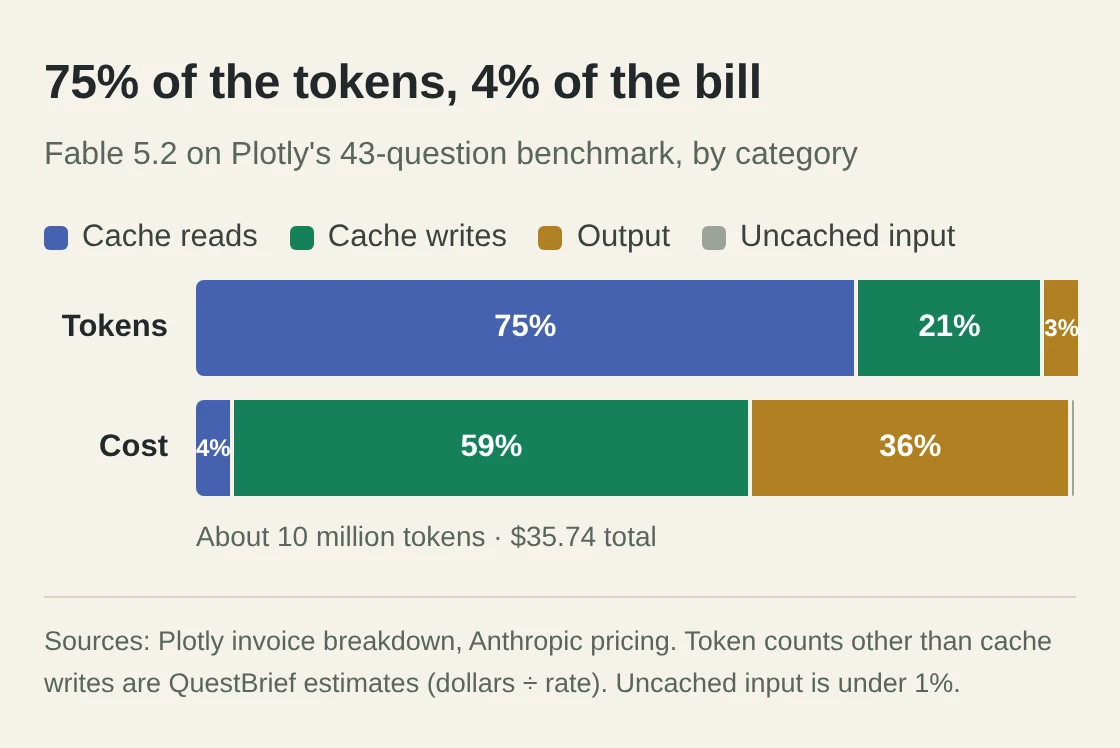
So on this workload, the cheaper input rate barely mattered. The bill was driven by how much got written to the cache and how much the model wrote back. Plotly didn’t publish the same breakdown for 5.1. But the math above says 5.1 didn’t just use fewer tokens. It used fewer of the expensive kind.
That split is one benchmark’s result, not a law. If your app reuses the same long system prompt for hours, most of your volume lands in cache reads, which Fable models bill at 0.025x the base input rate. And if you use the one-hour cache instead of the five-minute one, writes on 5.2 cost $16 per million, not $10.
Four numbers to pull from your own usage
Whether the 20% cut reaches your invoice comes down to your token mix, and you can measure it. Every Anthropic API response includes a usage block with input_tokens, cache_creation_input_tokens, cache_read_input_tokens and output_tokens.
Run a handful of representative jobs on your current model and log those four numbers. Then run the same jobs on Fable 5.2 and multiply each column by the table above. Since every 5.2 rate is 80% of 5.1’s, you save money as long as 5.2 doesn’t use more than 25% extra tokens in the same mix. Plotly’s run went past that line in the expensive columns.
On coding, Anthropic’s own numbers point the other way
All of this makes Fable 5.2 sound pricey, but Anthropic’s coding results tell a different story. On FrontierCode 2.0, which checks whether open-source maintainers would merge a model’s code changes, Fable 5.2 at High effort scored 45.3%. That’s about the same as Opus 5.5’s best score of 45.5%, and Anthropic says it got there “for roughly half the cost per task.” At Xhigh effort it hit 49.1%, the highest of any released model Anthropic has tested.
Look at the pricing table again and that claim is bolder than it sounds. Fable 5.2’s input and output rates are exactly double Opus 5.5’s. Double the rate at half the cost per task means, with a similar mix, Fable billed roughly a quarter of the tokens Opus did. That’s the opposite of what Plotly saw against 5.1.
Which picture fits your work isn’t settled yet. Anthropic’s “half the cost” is its own measurement against Opus 5.5. Plotly’s higher bill is against Fable 5.1. Among the sources checked for this piece, nobody has published Fable 5.2 and Opus 5.5 side by side on the same real workload with dollar totals. Anthropic itself still tells most users to start with Opus 5.5, “our strongest daily driver,” and pitches Fable 5.2 as an Advisor that smaller models consult on hard problems, or an Orchestrator that hands simpler tasks down to them.
Time is the cost you’ll notice first
Spring Prompt’s review covers the other cost: waiting. On SurveyBench, which tests survey data analysis, Fable 5.2 took 337 seconds and $1.51 per task. GPT-6.1 Sol took 222 seconds and $0.14. That’s 1.5x the time but 10.8x the money, so the price gap is far bigger than the speed gap. Fable 5.2 also won, though: 1,683, first of 17 models and 198 points ahead of second-place Muse Wonder.
Thinking is always on, and that hurts in interactive use. On eight creative coding prompts, the default setting spent the whole 128,000-token output limit thinking and returned nothing until Spring Prompt lowered the effort. In BulletBench chess, Fable 5.2 lost its first four 10-second games on time and was screened out. At three minutes plus a two-second increment, it won four of eight and lost the rest on time. Anthropic’s fast mode doubles the price to $16/$80 for up to 2.5x faster generation, but nothing in the announcement says it shortens thinking.
Where being slow but right is the point, the results hold up. On ROASBench, a simulated 12-month ad budget for a skincare brand, Fable 5.2 scored 61.3 to finish first of 28 and never overspent in any month. Anthropic also reports that 1,000 Fable 5.2 agents formalized Fermat’s Last Theorem in Lean in 30 hours, where Opus 5.5 managed 26% in 18 hours with the same setup.
A test you can run this week
For launch week, eligible paid plans that include Fable get one to three Fable resets depending on how long you’ve subscribed, and Pro plans and standard Team seats can use Fable for up to 50% of their weekly limits. That’s a free shot at the comparison nobody has published. Take the task you usually leave Opus 5.5 grinding on longest, give it to both models, and see which answer you’d rather ship. If Fable wins, log those four usage numbers on the API before you switch any traffic. The 20% on the rate card is the same for everyone. What shows up on your invoice depends on your workload.