If you’re running Gemini 4 Argon (gemini-4-argon) through the Gemini API, mark December 1 on your calendar. Google’s official pricing page now lists two sets of rates for the model: the current ones, which apply through November 30, 2026, and new ones starting December 1. Every line doubles. Input, output, caching, and every tier from Batch to Priority. Net Trends covered the change on November 2, and the numbers on the pricing page match.
Because the increase is flat across the board, there’s no tier you can hide in. The useful question isn’t “where do I move to avoid it?” but “what will the same workload cost, and which parts of it can run cheaper?”
The new rates, tier by tier
All prices below are USD per 1M tokens on the paid tier, straight from the pricing page.
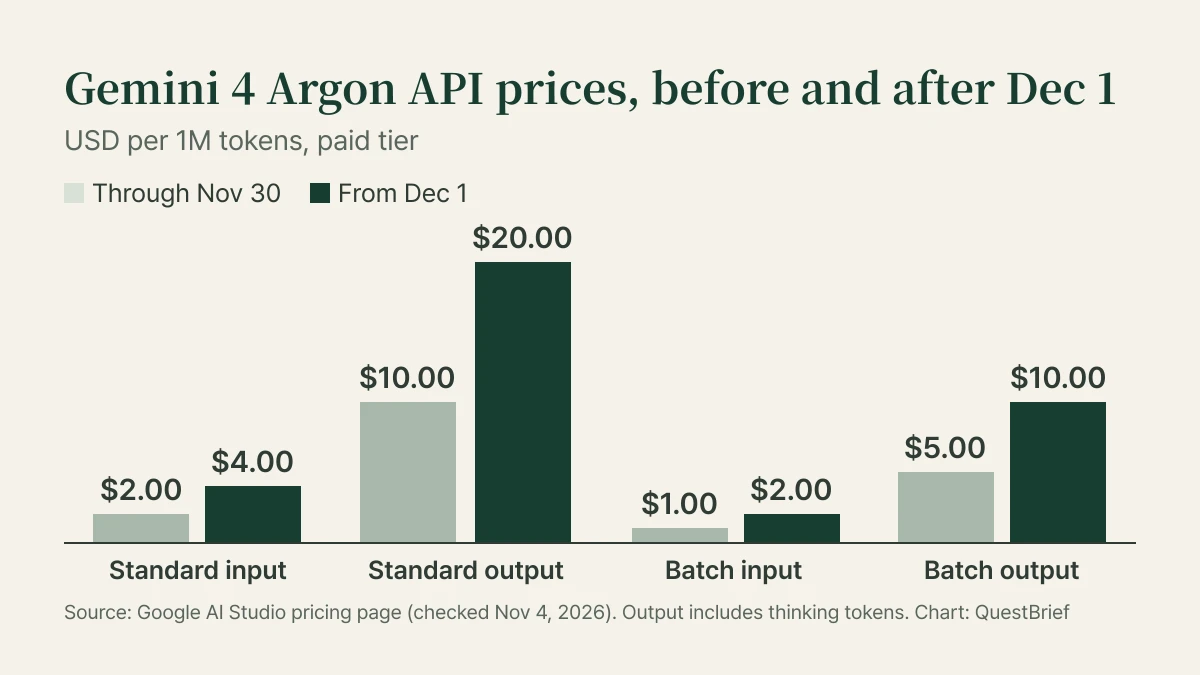
On the Standard tier, input goes from $2.00 to $4.00 and output from $10.00 to $20.00. Context caching rises from $0.10 to $0.20, and the page notes that Argon supports implicit caching only, so explicit caching isn’t an option.
Batch moves from $1.00 to $2.00 for input, $5.00 to $10.00 for output, and $0.05 to $0.10 for caching. Flex is priced the same as Batch. Priority goes from $3.60 to $7.20 for input and from $18.00 to $36.00 for output, so it takes the biggest hit in absolute dollars.
One detail is easy to miss. The output row is labeled as “including thinking tokens.” The reasoning the model does before it answers is billed as output. If your prompts trigger long reasoning, your output volume is bigger than the visible answer suggests, and a doubled output rate lands harder.
Also worth knowing: the pricing page says Gemini 4 Argon isn’t available on the free tier at all.
A worked example
Per-token prices are hard to feel, so here’s a concrete scenario. Say your app uses 30M input tokens and 5M output tokens a month. That’s roughly the shape of an internal coding assistant or a support-ticket summarizer, where input dwarfs output. These are our own calculations from the official rates, without any caching discount.
On Standard in November, that’s $60 for input plus $50 for output, or $110 a month. The same usage in December costs $120 plus $100, or $220 a month. On Priority it would be $396 a month after the change.
Here’s the interesting part. Run that same workload on Batch after December 1 and you pay $60 for input and $50 for output. That’s $110 again, exactly what Standard costs today. If a job doesn’t need a real-time response, moving it to Batch or Flex cancels out the increase for that job.
It’s not just Argon
The same pricing page shows Gemini 3.8 Flash on a similar path, one month later. Starting January 1, 2027, Flash goes from $0.75 to $1.50 for input and from $3.75 to $7.50 for output. Its cache storage price also doubles, from $0.50 to $1.00 per 1M tokens per hour.
So “just drop down to Flash” needs a second look too. Our example workload costs $41.25 a month on Flash Standard today and $82.50 after January 1. That’s still far below Argon’s $220, but whether the quality gap matters for your task is something only your own evals can tell you.
What to do before December
Start by pulling your real usage and checking how much of it is output, especially thinking tokens. The heavier your output share, the more this change will sting.
Next, look for work that doesn’t need an instant answer: nightly batch jobs, bulk classification, backfills. As the example shows, moving those to Batch or Flex keeps them at today’s effective cost.
And if you have a large one-off job planned, running it in November locks in the current rates, since they apply through November 30.
What’s still unclear
Neither the pricing page nor the Net Trends piece gives a reason for the increase, and the page doesn’t describe today’s rates as introductory or launch pricing. We also haven’t confirmed whether the same schedule applies to Gemini through Vertex AI, or whether anything changes for Gemini app subscriptions, which are billed separately from the API.