Open GitHub’s weekly trending page as of November 4 and one thing jumps out. Seven of the 15 repos are skills for coding agents like Claude Code and Codex. Add Impeccable, a design toolkit for agents, and it’s eight. And the ones pulling the most stars aren’t dev workflows or SEO helpers. They’re design skills that promise UIs that don’t look AI-generated.
The community mood is a lot cooler than the star counts suggest, though. We read 197 comments across eight Hacker News threads and scanned 75 recent GitHub issues on the biggest design skills. “I tried it and it still converges on the same look” comes up again and again. Here’s where the hype and the doubt part ways.
Design skills are at the top this week
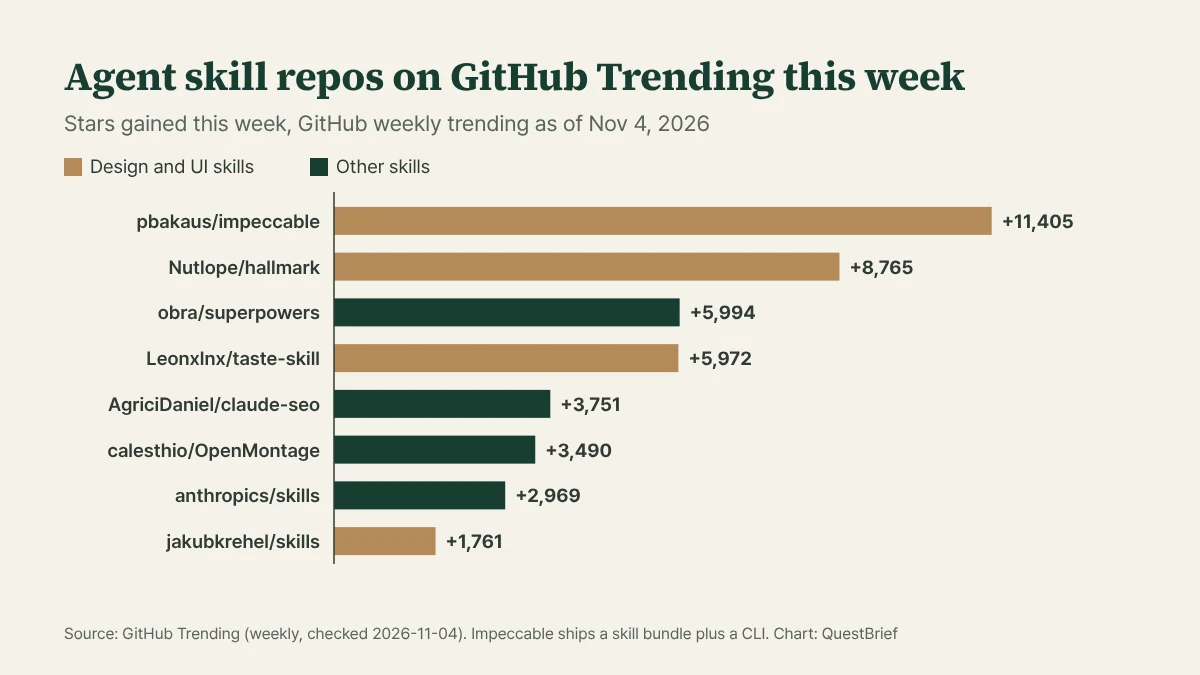
Chart: QuestBrief, from GitHub Trending numbers
Impeccable leads the week with 11,405 new stars, and Hallmark is second with 8,765. Taste Skill picked up 5,972, basically tied with Superpowers (5,994), the popular dev-methodology skill bundle. Count jakubkrehel/skills, a set of interface-building skills, and four of those eight repos are about design. Superpowers still dwarfs everyone on total stars at over 312,000, but the momentum right now is on the design side.
The pitches sound alike. Hallmark’s repo literally calls itself an “anti-AI-slop design skill.” Taste Skill promises art direction, reference images and a browser check “instead of generic AI pages.” Same target, different tooling.
Why “taste” is suddenly selling
The backdrop is fatigue with AI-built sites all looking the same. In April, developer Adrian Krebs loaded the landing pages of 1,590 Show HN submissions in a headless browser and checked each one for 16 “AI design patterns”: Inter everywhere, so-called “VibeCode Purple,” badges above the H1, identical icon-topped feature cards, low-contrast body text and so on. 22% of sites hit four or more patterns, 32% hit two or three, and 46% hit zero or one. His own verdict: “Is this bad? Not really, just uninspired.”
The HN thread on that post drew 234 comments. Reading the 72 top-level ones, reactions split. Some pushed back that these patterns were everywhere before AI, thanks to Tailwind UI and shadcn. One commenter said the list was already outdated because most vibe-coded sites now follow one model’s house style. Two people were sad that colored left borders they’d used for years are now an “AI tell.” And a few argued the real problem isn’t the look at all, it’s that the substance behind the look is vibe-coded.
So the perception that AI UIs are easy to spot is widespread, and “give your agent taste” skills showed up as the answer.
“I tried it, and it all converges”
The question is whether the answer works. In the July HN thread for Hallmark (nine comments), doubt was the dominant note. One user asked whether anyone had gotten Hallmark, Impeccable or anything similar “to actually work,” because for them it still looked like slop. Another said they’d used Impeccable and many other design skills, and they “all seem to converge on the same thing.” Helpful for consistency and accessibility, but the design itself stays the same unless you’re extremely explicit. Someone else pointed out that most of the example screenshots in Hallmark’s README already look AI-generated.
There was a defense too. One reply noted that Hallmark keeps a log of past builds in .hallmark/log.json and hard-fails a run that repeats recent page structures or themes. At least it attacks the convergence problem head-on.
The doubt isn’t new. Back in January, a Show HN for a skill that promised “consistent UI from Claude Code” got a comment noticing that many of its examples shared the same terracotta and warm-cream palette. The commenter said Anthropic’s official frontend-design skill had handed them the same cream tones, unprompted, more than once.
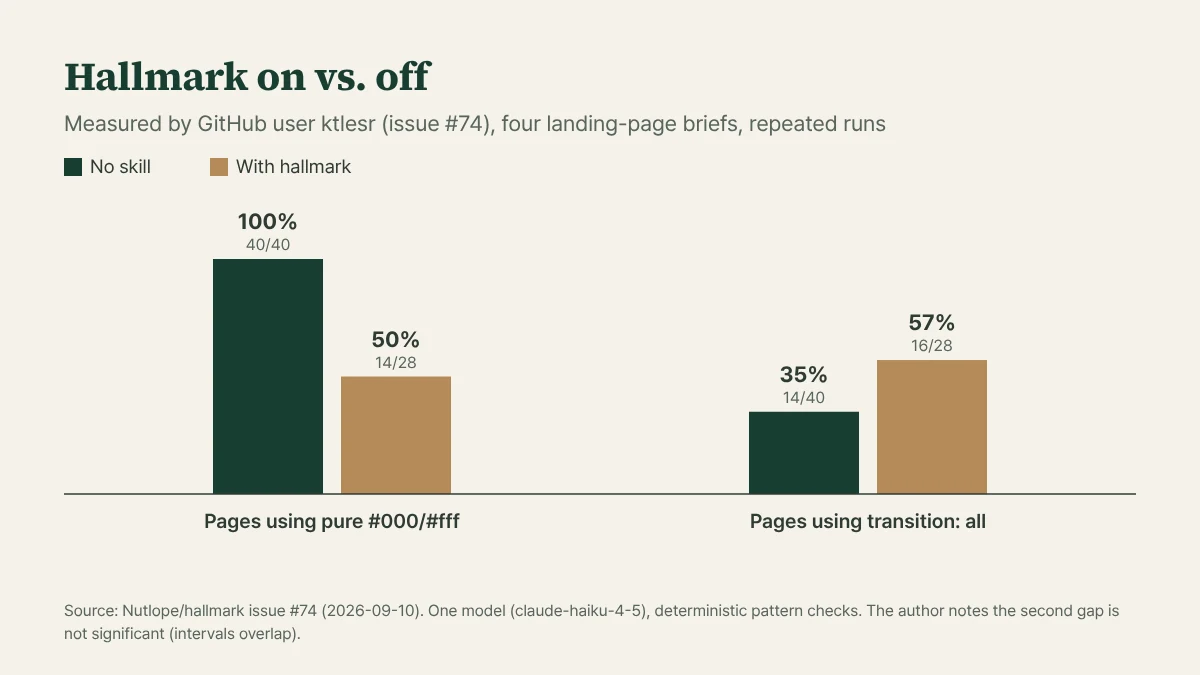
Chart: QuestBrief, from the measurements in Hallmark issue #74
One user actually measured it. In Hallmark issue #74, ktlesr generated four landing-page briefs repeatedly with and without the skill and scored the output with deterministic pattern checks. Pages using pure black and white dropped from 100% to 50%, a real effect. But transition: all, which Hallmark bans, went up from 35% to 57%. The author flags that the intervals overlap, so that one isn’t significant.
The observations around the numbers are even more telling. In this test, Hallmark activated in 0 of 12 runs when the prompt didn’t name it, and 40 of 40 when it did. In 12 of the 40 skill runs, the model stopped to ask design-context questions and built nothing. And it never opened the reference files where most of the banned patterns are defined. It’s one model (claude-haiku-4-5) and 28 to 40 pages per arm, so don’t over-generalize. Still, it’s a long way from “install it and your UIs get better.”
Cost comes up too. Hallmark issue #50 points out the skill is about 1 MB, so the model burns “a LOT of tokens” just reading it before doing any work, and asks for the commands to be split into separate skills. Over on Taste Skill, a late-October issue titled “Taste Skill Not Working” says the skill followed the brief and produced “terrible design.”
Doubts about skills in general
This isn’t only about design. On HN, whether skills actually improve results has been argued all year.
The SkillsBench paper from February is the reference point. Its first version tested 86 tasks and found that curated skills raised the average pass rate by 16.2 percentage points, but with huge variation by domain: +4.5 points for software engineering versus +51.9 for healthcare. Skills the model wrote for itself provided no benefit on average. The June revision (v4) lists 87 tasks and a 16.6-point gain, and adds that focused skills with at most three modules beat large, exhaustive bundles.
The paper’s HN thread (167 comments) was first submitted as “Study: Self-generated agent skills are useless” before a moderator restored the original title. About 10 of the 39 top-level comments took aim at the setup: of course a skill written purely from the model’s own knowledge adds nothing, while useful skills come from capturing what you learned after working through a problem. Others said the real headline was that software engineering, the field most people use skills for, showed the smallest gain.
The thread on Addy Osmani’s Agent Skills bundle in May (200 comments) was frostier. We sorted the 41 top-level comments ourselves: 10 questioned whether skills like these help or are needed, and 6 found them useful. Four asked how it compares to Superpowers or spec-kit, and four suspected the post or the skills were AI-written. One line captures the critique well: people who write this stuff skip the boring parts, meaning benchmarks and with/without comparisons.
There’s also fatigue when skills get mandated. In a May Ask HN, a developer said their new team at a large company banned writing code by hand and required a Superpowers/speckit-style internal framework with 100+ agents and skill files. About seven of the 15 replies said some version of “this isn’t the future” or “this can’t last,” including one from someone who’d seen a similar team pass tests and fall apart in real use.
Then there’s July’s Ask HN asking which “must-have” skills people have deleted. The poster said stronger models let them drop multi-step workflows like Superpowers, and a reply noted that code review is now built into Claude Code and Codex. Put that next to Superpowers still gaining nearly 6,000 stars this week and you get a picture of newcomers piling in while early adopters prune.
Before you hit install
claude-mem, sitting at the top of this week’s trending list with about 112,000 total stars, is a memory plugin rather than a skill, but it lives in the same ecosystem. According to issue #5176, filed October 29, running the interactive installer from v15.2.0 onward opened a setup page that automatically collected the last 30 days of prompts from Claude Code, Codex, Gemini CLI and other tools and uploaded them to cmem.ai, full text plus session IDs, project names and folder paths. The only checkbox was ticked by default, and the reporter says unticking it didn’t stop the upload.
The maintainer closed the issue on November 2 with a PR titled “require explicit consent before uploading prompts,” then reopened it the same day. A follow-up asking how already-uploaded data gets deleted has no reply yet. The same story was posted to HN but barely registered (3 points, no comments).
The design skills have their own issues in this vein. Taste Skill had a DOM XSS report about chart scripts passing unescaped data to innerHTML (now closed), and Impeccable had a docs issue about a command that could run agents with permission checks off (also closed). Stars aren’t an audit. A skill is a bundle of instructions and scripts you’re handing to an agent with access to your machine, so reading what the installer does is on you.
Research period and sample
- Hacker News: 8 threads posted between January 20 and July 30, 2026, with 197 comments read (top-level only on the long threads). By thread: AI design patterns 72, Agent Skills 41, SkillsBench 39, Ask HN on mandated workflows 15, agent-skills-eval 10, Hallmark 9, consistent-UI skill 8, deprecated skills 3. Five related posts from May to October had no comments, so we checked only their titles and scores.
- GitHub issues: the first page (25 issues each) of recent issues for Hallmark, Taste Skill and Impeccable, 75 issues in all, dated July 15 to November 4. We read the full text and comments of Hallmark #50 and #74, Taste Skill #173 and claude-mem #5176.
- Limits: Reddit and X weren’t reachable from our research environment. HN skews toward developers, so it may not reflect everyone installing design skills. The comment categories are our own sorting, and one comment can fall into more than one.